Pages

Showing posts with label new york. Show all posts

You Can Buy JAR Jewelry at Metropolitan Museum Exhibition

La Dame Aux Gardenias (The Invisible Flower of Madame X), white resin & 18k clip earrings, $4,000.

As I previously promised, I have the photographs of jewelry by Joel A. Rosenthal, better known to jewelry lovers across the globe as JAR, that he created specifically for the exhibition, Jewels By JAR, which opens Wednesday at the Metropolitan Museum of Art and runs till March 9, 2014. They are available for purchase exclusively at the museum.

Carnaval à Venise red titanium earrings with gold Venetian glass, $2,000.

The pieces include earrings made of resin, 18k over aluminum, titanium and Venetian glass ranging in price from $2,000 to $7,500. There are also two watches designed for the event that cost $600. These creations will be available exclusively at the Museum through the close of the exhibition. These are not limited edition pieces but they are numbered.

Tickle Me Feather clip earrings, 18k over aluminum, $7,500.

The exhibition will be the first retrospective in the United States of JAR’s work and the first retrospective at the Metropolitan Museum devoted to a contemporary artist of gems. It is only the second time his pieces were available to be seen at an exhibition, with the first being in London in 2002.

JAR watches in two styles, $600 each. Photo credit: Anthony DeMarco

Born in New York and educated at Harvard, Rosenthal moved to Paris soon after graduation and began to experiment with jewelry making. He opened JAR in 1978 on the Place Vendôme, in the same space he occupies today.

Carnaval à Venise black titanium earrings with gold Venetian glass, $2,000.

“JAR jewels became known for their unique design, the exquisite quality of the gemstones, and their remarkable craftsmanship—but above all for their fearless beauty,” the museum said in a statement. “Rosenthal’s one-of-a-kind creations place him among the ranks of history’s greatest jewelers.”

Tickle Me Feather violet clip earrings made of resin and 18k gold, $4,000.

The exhibition is described by the museum as a retrospective of his work for the 35 years he’s been designing jewelry under the JAR name. The exhibition of 400 works, mostly from private collections, presents a rare glimpse into the work of JAR and the museum store provides a rare opportunity to buy one of his pieces. 


Please join me on the Jewelry News Network Facebook Page, on Twitter @JewelryNewsNet and on the Forbes Website.
La Dame Aux Gardenias (The Invisible Flower of Madame X), white resin & 18k clip earrings, $4,000.

As I previously promised, I have the photographs of jewelry by Joel A. Rosenthal, better known to jewelry lovers across the globe as JAR, that he created specifically for the exhibition, Jewels By JAR, which opens Wednesday at the Metropolitan Museum of Art and runs till March 9, 2014. They are available for purchase exclusively at the museum.

Carnaval à Venise red titanium earrings with gold Venetian glass, $2,000.

The pieces include earrings made of resin, 18k over aluminum, titanium and Venetian glass ranging in price from $2,000 to $7,500. There are also two watches designed for the event that cost $600. These creations will be available exclusively at the Museum through the close of the exhibition. These are not limited edition pieces but they are numbered.

Tickle Me Feather clip earrings, 18k over aluminum, $7,500.

The exhibition will be the first retrospective in the United States of JAR’s work and the first retrospective at the Metropolitan Museum devoted to a contemporary artist of gems. It is only the second time his pieces were available to be seen at an exhibition, with the first being in London in 2002.

JAR watches in two styles, $600 each. Photo credit: Anthony DeMarco

Born in New York and educated at Harvard, Rosenthal moved to Paris soon after graduation and began to experiment with jewelry making. He opened JAR in 1978 on the Place Vendôme, in the same space he occupies today.

Carnaval à Venise black titanium earrings with gold Venetian glass, $2,000.

“JAR jewels became known for their unique design, the exquisite quality of the gemstones, and their remarkable craftsmanship—but above all for their fearless beauty,” the museum said in a statement. “Rosenthal’s one-of-a-kind creations place him among the ranks of history’s greatest jewelers.”

Tickle Me Feather violet clip earrings made of resin and 18k gold, $4,000.

The exhibition is described by the museum as a retrospective of his work for the 35 years he’s been designing jewelry under the JAR name. The exhibition of 400 works, mostly from private collections, presents a rare glimpse into the work of JAR and the museum store provides a rare opportunity to buy one of his pieces. 


Please join me on the Jewelry News Network Facebook Page, on Twitter @JewelryNewsNet and on the Forbes Website.
reade more... Résuméabuiyad

Jewels By Jar, a Dazzling Display of Darkness and Light

Butterfly Brooch, 1994; Sapphires, fire opals, rubies, amethyst, garnets, diamonds, silver and gold; Private collection. Photograph by Katharina Faerber. Courtesy of JAR, Paris

Jewelry is supposed to sparkle, glitter and glow. Joel A. Rosenthal, better known as JAR, also says it should “flicker,” which is why in his first exhibition in 2002 at the Somerset House in London, he requested that his jewelry be seen in the dark aided only by tiny flashlights.

Multicolored Handkerchief Earrings, 2011; Sapphires, demantoid and other garnets, zircons, tourmalines, emeralds, rubies, fire opals, spinels, beryls, diamonds, platinum, silver, and gold; Private collection. Photograph by Jozsef Tari. Courtesy of JAR, Paris.

Those visiting the Metropolitan Museum of Art for the landmark U.S. exhibition of Jewels By Jar won’t be asked to do anything drastic this time. However, in a museum bathed in light, the space dedicated to JAR is in darkness, with the exception of the spotted glow of jewelry displays.

Colored Balls Necklace, 1999; Rubies, sapphires, emeralds, amethysts, spinels, garnets, opals, tourmalines, aquamarines, citrines, diamonds, silver, and gold; Private collection. Photograph by Jozsef Tari. Courtesy of JAR, Paris.

The exhibition, which opens Wednesday and runs till March 9, 2014, is the first US viewing of jewelry by the famed and famously reclusive jewelry artist. The exhibition will be the first retrospective in the United States of his work and the first retrospective at the Metropolitan Museum devoted to a contemporary artist of gems.

Raspberry Brooch, 2011; Rubies, diamonds, bronze, silver, gold, and platinum. Collection of Sien M. Chew. Photograph by Jozsef Tari. Courtesy of JAR, Paris.

The press preview Monday at the museum was my first opportunity to see JAR jewelry pieces in the flesh and it didn’t disappoint. The 400 pieces on display, nearly all lent by private collectors, represent 35 years of designing jewelry at the highest level.

Lilac Brooches, 2001; Diamonds, lilac sapphires, garnets, aluminum, silver, and gold; Private collection. Photograph by Jozsef Tari. Courtesy of JAR, Paris.

It’s obvious that Rosenthal isn’t a just a jewelry designer but an artist. In brief words during the press preview Monday, Jane Adlin, the exhibition curator, was a bit more specific, describing him as a sculptor.

Poppy Brooch, 1982; Diamond, tourmalines, and gold; Private collection. Photograph by Katharina Faerber. Courtesy of JAR, Paris

“I think Joel is best known for his technique of pavé. He’s discriminating but indiscriminate in his use of gemstones,” Adlin said. “So he’ll mix very, very fine perfectly cut, perfectly flawless gemstones with some that are not. He will use lesser quality stones. He will use lesser-known stones. But the outcome is this extraordinary piece of jewelry, which if you just put it on your dresser or your coffee table it would in fact be a piece of sculpture.”

Bracelet, 2010; Diamonds, silver, and platinum; Private collection. Photograph by Jozsef Tari. Courtesy of JAR, Paris

That’s probably the best way to look at the works of JAR. From the time of the Greeks, great sculptors are able to take a subject and create a more perfect vision of it. That’s part of Rosenthal’s skill and expertise. For example, his flowers and animals, in addition to being precise, seem to be more perfect than what nature intended. He can create texture with jewels, such as his colorful handkerchief earrings in which one has a fold. And, as previously mentioned, there’s his exemplary use of pavé combined with exceptional colors from the many types of gems he’ll use for a single piece. He treats metals the same way in his pieces as it ranges from gold, platinum and titanium to silver and aluminum.

Earrings, 2011; Emeralds, oriental pearls, diamonds, and platinum; Private collection. Photograph by Jozsef Tari. Courtesy of JAR, Paris.

His 1994 butterfly brooch (one of many he created over the years) may be the best example of all of his sculptural attributes. Like many of his pieces it’s a combination of multiple materials. In this case sapphires, fire opals, rubies, amethyst, garnets, diamonds, silver and gold. Colors include different shades of violet, red, orange, yellow, blue and green with specks of white. Micro pavé is used throughout. In some cases there’s clear separation of color, in other parts of the creature, the colors seem to blend together.

Zebra Brooch, 1987; Agate, diamonds, a sapphire, silver, and gold; Private collection. Photograph by Katharina Faerber. Courtesy of JAR, Paris.

The mystique of JAR is enhanced by the man himself. Rosenthal is famously private. The New York native who lives and works in Paris has rarely given interviews although he did agree to a select few for this exhibition. The window of his store on Place Vendôme, perhaps the most famous luxury shopping district in the world, is often blank or showing a single object unrelated to jewelry design, such as a twig. The customers who are fortunate enough to enter his chambers get singular treatment and leave, eventually, with unique pieces of art created just for them.

Tulip Brooch, 2008; Rubies, diamonds, pink sapphires, garnets, silver, gold, and enamel; Private collection; Photograph by Jozsef Tari. Courtesy of JAR, Paris.

His eccentricity was apparently on display during the preparation of the Met exhibit. To the disappointment of many Rosenthal wasn’t present at the press preview with staff saying he is “shy.”

But we did get a bit more detail of the man behind JAR from Jennifer Russell, Metropolitan Museum associate director for exhibitions.

“Joel is passionate, he’s opinionated, he has a very definite point of view about almost everything, from what he’s going to eat for lunch to how the show should be arranged,” she said. “But he listens too and it’s been a wonderful dialogue in deciding how things should be arranged and discussing the exhibition in general.”

Please join me on the Jewelry News Network Facebook Page, on Twitter @JewelryNewsNet and on the Forbes Website.

Butterfly Brooch, 1994; Sapphires, fire opals, rubies, amethyst, garnets, diamonds, silver and gold; Private collection. Photograph by Katharina Faerber. Courtesy of JAR, Paris

Jewelry is supposed to sparkle, glitter and glow. Joel A. Rosenthal, better known as JAR, also says it should “flicker,” which is why in his first exhibition in 2002 at the Somerset House in London, he requested that his jewelry be seen in the dark aided only by tiny flashlights.

Multicolored Handkerchief Earrings, 2011; Sapphires, demantoid and other garnets, zircons, tourmalines, emeralds, rubies, fire opals, spinels, beryls, diamonds, platinum, silver, and gold; Private collection. Photograph by Jozsef Tari. Courtesy of JAR, Paris.

Those visiting the Metropolitan Museum of Art for the landmark U.S. exhibition of Jewels By Jar won’t be asked to do anything drastic this time. However, in a museum bathed in light, the space dedicated to JAR is in darkness, with the exception of the spotted glow of jewelry displays.

Colored Balls Necklace, 1999; Rubies, sapphires, emeralds, amethysts, spinels, garnets, opals, tourmalines, aquamarines, citrines, diamonds, silver, and gold; Private collection. Photograph by Jozsef Tari. Courtesy of JAR, Paris.

The exhibition, which opens Wednesday and runs till March 9, 2014, is the first US viewing of jewelry by the famed and famously reclusive jewelry artist. The exhibition will be the first retrospective in the United States of his work and the first retrospective at the Metropolitan Museum devoted to a contemporary artist of gems.

Raspberry Brooch, 2011; Rubies, diamonds, bronze, silver, gold, and platinum. Collection of Sien M. Chew. Photograph by Jozsef Tari. Courtesy of JAR, Paris.

The press preview Monday at the museum was my first opportunity to see JAR jewelry pieces in the flesh and it didn’t disappoint. The 400 pieces on display, nearly all lent by private collectors, represent 35 years of designing jewelry at the highest level.

Lilac Brooches, 2001; Diamonds, lilac sapphires, garnets, aluminum, silver, and gold; Private collection. Photograph by Jozsef Tari. Courtesy of JAR, Paris.

It’s obvious that Rosenthal isn’t a just a jewelry designer but an artist. In brief words during the press preview Monday, Jane Adlin, the exhibition curator, was a bit more specific, describing him as a sculptor.

Poppy Brooch, 1982; Diamond, tourmalines, and gold; Private collection. Photograph by Katharina Faerber. Courtesy of JAR, Paris

“I think Joel is best known for his technique of pavé. He’s discriminating but indiscriminate in his use of gemstones,” Adlin said. “So he’ll mix very, very fine perfectly cut, perfectly flawless gemstones with some that are not. He will use lesser quality stones. He will use lesser-known stones. But the outcome is this extraordinary piece of jewelry, which if you just put it on your dresser or your coffee table it would in fact be a piece of sculpture.”

Bracelet, 2010; Diamonds, silver, and platinum; Private collection. Photograph by Jozsef Tari. Courtesy of JAR, Paris

That’s probably the best way to look at the works of JAR. From the time of the Greeks, great sculptors are able to take a subject and create a more perfect vision of it. That’s part of Rosenthal’s skill and expertise. For example, his flowers and animals, in addition to being precise, seem to be more perfect than what nature intended. He can create texture with jewels, such as his colorful handkerchief earrings in which one has a fold. And, as previously mentioned, there’s his exemplary use of pavé combined with exceptional colors from the many types of gems he’ll use for a single piece. He treats metals the same way in his pieces as it ranges from gold, platinum and titanium to silver and aluminum.

Earrings, 2011; Emeralds, oriental pearls, diamonds, and platinum; Private collection. Photograph by Jozsef Tari. Courtesy of JAR, Paris.

His 1994 butterfly brooch (one of many he created over the years) may be the best example of all of his sculptural attributes. Like many of his pieces it’s a combination of multiple materials. In this case sapphires, fire opals, rubies, amethyst, garnets, diamonds, silver and gold. Colors include different shades of violet, red, orange, yellow, blue and green with specks of white. Micro pavé is used throughout. In some cases there’s clear separation of color, in other parts of the creature, the colors seem to blend together.

Zebra Brooch, 1987; Agate, diamonds, a sapphire, silver, and gold; Private collection. Photograph by Katharina Faerber. Courtesy of JAR, Paris.

The mystique of JAR is enhanced by the man himself. Rosenthal is famously private. The New York native who lives and works in Paris has rarely given interviews although he did agree to a select few for this exhibition. The window of his store on Place Vendôme, perhaps the most famous luxury shopping district in the world, is often blank or showing a single object unrelated to jewelry design, such as a twig. The customers who are fortunate enough to enter his chambers get singular treatment and leave, eventually, with unique pieces of art created just for them.

Tulip Brooch, 2008; Rubies, diamonds, pink sapphires, garnets, silver, gold, and enamel; Private collection; Photograph by Jozsef Tari. Courtesy of JAR, Paris.

His eccentricity was apparently on display during the preparation of the Met exhibit. To the disappointment of many Rosenthal wasn’t present at the press preview with staff saying he is “shy.”

But we did get a bit more detail of the man behind JAR from Jennifer Russell, Metropolitan Museum associate director for exhibitions.

“Joel is passionate, he’s opinionated, he has a very definite point of view about almost everything, from what he’s going to eat for lunch to how the show should be arranged,” she said. “But he listens too and it’s been a wonderful dialogue in deciding how things should be arranged and discussing the exhibition in general.”

Please join me on the Jewelry News Network Facebook Page, on Twitter @JewelryNewsNet and on the Forbes Website.

reade more... Résuméabuiyad

Montblanc Honors Sanford I. Weill With Arts Patronage Award

Sanford I. Weill accepting Montblanc de la Culture Arts Patronage Award.

Sanford I. Weill has amassed a fortune by buying a small business and through a series of acquisitions turned it into the world’s largest company. 

The former CEO and chairman of Citigroup has been praised and vilified as the person most responsible for the “shattering” of the Glass–Steagall Act (which separated banking and insurance businesses and limited the investing risk banks could take), creating the modern financial services industry.

On Monday, Weill was being honored not because of his business success but because of his longtime philanthropy. Among the organizations that have benefited from his and wife’s Joan’s financial and personal commitment are the Academy of Finance, a joint program with the New York City Board of Education that trains high school students for careers in financial services, and Carnegie Hall, where he serves as board chairman. 

Sanford Weill in center holding his award. From left: Jan-Patrick Schmitz, Montblanc North America CEO and president, Lang Lang, Clive Gillinson, Carnegie Hall executive and artistic director, and Lutz Bethge, vice chairman of the Montblanc Cultural Foundation.

The 80-year-old businessman and philanthropist received the Montblanc de la Culture Arts Patronage Award during an intimate lunch at Per Se New York. In a soft voice, he explained why it is up to those who have had success in business to take a leadership role in supporting arts and education. 

“As we think about the world we live in most of the governments that we know of, certainly in the developing world, don’t have much money,” he said. “What we really count on for education, culture or art, and healthcare is really not the place we can look at anymore. We’re going to have to think about how we create more public-private partnerships.” 

Even though Weill has given hundreds of millions of dollars to various causes, he said it takes more than money to make a good philanthropist. 

“Philanthropy is not just about giving money because people can give money to just solve their conscience but it’s also about having passion for something, giving your intelligence. What makes you successful in the private sector is also going to make you successful in the public sector. People shouldn’t say I’m busy, the company’s growing. I don’t have the time to do this.”

He added, “It really is better to give than to receive and when you give, you receive so much more.”

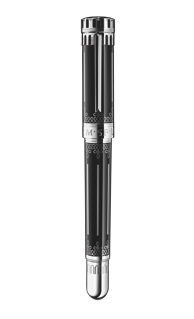
Weill was presented with a 15,000 euro cash award and a “Patron of Art Edition 2013 Ludovico Sforza, Duke of Milan” writing instrument (one of 12), commemorating the life and influence of Sforza, one of the most prominent patrons of the Italian Renaissance and a great supporter of Leonardo Da Vinci.

Gold Patron of Art Edition 2013 Ludovico Sforza, Duke of Milan Limited Edition 888.

The public will have the opportunity of purchasing two editions of this writing instrument: a gold model limited to 888 units and a silver model limited to 4,810 units.

Silver Patron of Art Edition 2013
Ludovico Sforza,  Duke of Milan
Limited Edition 4810.
Cylindrical towers on the cap and clip design were taken from the Castello Sforzesco in Milan, home to the ducal dynasty. The writing instrument’s fittings replicate the pattern Da Vinci, used in his fresco in the “Sala delle Asse” (“Chamber of Boards”) as well as in the Mona Lisa’s robes and ornaments. The initials engraved on the cap’s ring originate from a silver coin issued in honor of Sforza during the Milanese Renaissance. 

The gold model is offset with a blue lacquered cap and barrel. The silver edition is in black lacquer.

Prior to the luncheon ceremony, Lutz Bethge, vice chairman of the Montblanc Cultural Foundation, explained that the patron of the arts awards, in its 22nd year, honors historical and modern persons who have a long history of giving their time and talents to supporting the arts and art projects. Each year an historical figure is chosen as the inspiration behind a limited-edition writing instrument. Then a modern-day patron of the arts chosen each year in 12 countries is presented with that pen, cash awards and the recognition that will hopefully inspire others to do the same. To bring the program to a larger audience, the brand made the same writing instrument available for sale in limited editions. In fact, Bethge said the popularity of this program spawned Montblanc’s highly-successful limited-edition business. 

“It was almost by chance and it is because of this award,” he said inside Montblanc’s new boutique at 600 Madison Ave.

While the award has been given to a broad group of people, Bethge and Jan-Patrick Schmitz, Montblanc North America CEO and president, did say that it is unusual to present such an award to someone from the financial services industry. However, Weill’s financial and personal contributions are part of a long history of patronage to the arts from royalty to today’s business leaders. 

“(In choosing Weill) we wanted to tell the story that the arts need patronage to flourish,” Bethge said. “This is a patronage award for arts and culture.” 

In addition, Weill’s commitment to education (as well as arts) is in line with the cultural commitment of Montblanc as a company that sells writing instruments, one of the most basic tools used for human communication. 

“Our mark is on the writing culture,” Bethge said. “It is the most important thing of mankind.”

Bethge and Schmitz explained in great detail that in each country there are juries that select nominees and then all of the juries together select the winner in each country. However, there is also a personal connection between the man and the brand: Lang Lang. 

Lang Lang performs for Sanford Weill.

The 31-year-old concert pianist is the chairman of the Montblanc Cultural Foundation. He has also known Weill since he was 17 years old and considers him a mentor as well as friend. Weill serves as director of the Lang Lang International Music Foundation.

The affection between the two was obvious throughout the event. Lang Lang gave him a big bear hug, something that Weill says he has been the recipient of throughout their 14-year relationship. He played three short compositions in Weill’s honor.

“Without you it would be a very different world,” Lang Lang said. “You really make our world better and because of you we have the confidence to shape our own world.” 

Please join me on the Jewelry News Network Facebook Page, on Twitter @JewelryNewsNet and on the Forbes Website.
Sanford I. Weill accepting Montblanc de la Culture Arts Patronage Award.

Sanford I. Weill has amassed a fortune by buying a small business and through a series of acquisitions turned it into the world’s largest company. 

The former CEO and chairman of Citigroup has been praised and vilified as the person most responsible for the “shattering” of the Glass–Steagall Act (which separated banking and insurance businesses and limited the investing risk banks could take), creating the modern financial services industry.

On Monday, Weill was being honored not because of his business success but because of his longtime philanthropy. Among the organizations that have benefited from his and wife’s Joan’s financial and personal commitment are the Academy of Finance, a joint program with the New York City Board of Education that trains high school students for careers in financial services, and Carnegie Hall, where he serves as board chairman. 

Sanford Weill in center holding his award. From left: Jan-Patrick Schmitz, Montblanc North America CEO and president, Lang Lang, Clive Gillinson, Carnegie Hall executive and artistic director, and Lutz Bethge, vice chairman of the Montblanc Cultural Foundation.

The 80-year-old businessman and philanthropist received the Montblanc de la Culture Arts Patronage Award during an intimate lunch at Per Se New York. In a soft voice, he explained why it is up to those who have had success in business to take a leadership role in supporting arts and education. 

“As we think about the world we live in most of the governments that we know of, certainly in the developing world, don’t have much money,” he said. “What we really count on for education, culture or art, and healthcare is really not the place we can look at anymore. We’re going to have to think about how we create more public-private partnerships.” 

Even though Weill has given hundreds of millions of dollars to various causes, he said it takes more than money to make a good philanthropist. 

“Philanthropy is not just about giving money because people can give money to just solve their conscience but it’s also about having passion for something, giving your intelligence. What makes you successful in the private sector is also going to make you successful in the public sector. People shouldn’t say I’m busy, the company’s growing. I don’t have the time to do this.”

He added, “It really is better to give than to receive and when you give, you receive so much more.”

Weill was presented with a 15,000 euro cash award and a “Patron of Art Edition 2013 Ludovico Sforza, Duke of Milan” writing instrument (one of 12), commemorating the life and influence of Sforza, one of the most prominent patrons of the Italian Renaissance and a great supporter of Leonardo Da Vinci.

Gold Patron of Art Edition 2013 Ludovico Sforza, Duke of Milan Limited Edition 888.

The public will have the opportunity of purchasing two editions of this writing instrument: a gold model limited to 888 units and a silver model limited to 4,810 units.

Silver Patron of Art Edition 2013
Ludovico Sforza,  Duke of Milan
Limited Edition 4810.
Cylindrical towers on the cap and clip design were taken from the Castello Sforzesco in Milan, home to the ducal dynasty. The writing instrument’s fittings replicate the pattern Da Vinci, used in his fresco in the “Sala delle Asse” (“Chamber of Boards”) as well as in the Mona Lisa’s robes and ornaments. The initials engraved on the cap’s ring originate from a silver coin issued in honor of Sforza during the Milanese Renaissance. 

The gold model is offset with a blue lacquered cap and barrel. The silver edition is in black lacquer.

Prior to the luncheon ceremony, Lutz Bethge, vice chairman of the Montblanc Cultural Foundation, explained that the patron of the arts awards, in its 22nd year, honors historical and modern persons who have a long history of giving their time and talents to supporting the arts and art projects. Each year an historical figure is chosen as the inspiration behind a limited-edition writing instrument. Then a modern-day patron of the arts chosen each year in 12 countries is presented with that pen, cash awards and the recognition that will hopefully inspire others to do the same. To bring the program to a larger audience, the brand made the same writing instrument available for sale in limited editions. In fact, Bethge said the popularity of this program spawned Montblanc’s highly-successful limited-edition business. 

“It was almost by chance and it is because of this award,” he said inside Montblanc’s new boutique at 600 Madison Ave.

While the award has been given to a broad group of people, Bethge and Jan-Patrick Schmitz, Montblanc North America CEO and president, did say that it is unusual to present such an award to someone from the financial services industry. However, Weill’s financial and personal contributions are part of a long history of patronage to the arts from royalty to today’s business leaders. 

“(In choosing Weill) we wanted to tell the story that the arts need patronage to flourish,” Bethge said. “This is a patronage award for arts and culture.” 

In addition, Weill’s commitment to education (as well as arts) is in line with the cultural commitment of Montblanc as a company that sells writing instruments, one of the most basic tools used for human communication. 

“Our mark is on the writing culture,” Bethge said. “It is the most important thing of mankind.”

Bethge and Schmitz explained in great detail that in each country there are juries that select nominees and then all of the juries together select the winner in each country. However, there is also a personal connection between the man and the brand: Lang Lang. 

Lang Lang performs for Sanford Weill.

The 31-year-old concert pianist is the chairman of the Montblanc Cultural Foundation. He has also known Weill since he was 17 years old and considers him a mentor as well as friend. Weill serves as director of the Lang Lang International Music Foundation.

The affection between the two was obvious throughout the event. Lang Lang gave him a big bear hug, something that Weill says he has been the recipient of throughout their 14-year relationship. He played three short compositions in Weill’s honor.

“Without you it would be a very different world,” Lang Lang said. “You really make our world better and because of you we have the confidence to shape our own world.” 

Please join me on the Jewelry News Network Facebook Page, on Twitter @JewelryNewsNet and on the Forbes Website.
reade more... Résuméabuiyad

Winning Jewelry Designs From 2014 AGTA Spectrum Awards

Best of Show: 'Tropical Storm' Ring by James Currens of J.W. Currens. Platinum ring is centered with a 22.10-carat emerald surrounded by swirling patterns of diamonds (11.47 ctw.). This piece also took first place in the Classical category.

Colored gemstone jewelry took center stage Monday as the American Gem Trade Association announced the winners of its annual Spectrum Awards competition and allowed the press to view nearly all of the entries at an undisclosed location in New York. 

Best Use of Color: Erica Courtney's 18k yellow gold earrings feature boulder opals (22.84 ctw.) and fire opals (2.62 ctw.) accented with orange sapphires (1.75 ctw.) and Paraiba tourmalines (.70 ctw.). 

Lined up on tabletops in an unadorned room was a variety of pieces representing the wealth of diversity and creativity of the worldwide jewelry industry. The competition and showcase, in its 30th year, is organized by the American Gem Trade Association, a North American trade organization representing the colored gem and cultured pearl industries. This competition is by far the largest and most prestigious for those who create with natural colored gemstones and cultured pearls.

Best Use of Platinum and Color: "Coleman's Smokey Blues" earrings by Deirdre Featherstone of Featherstone Design feature cushion-cut blue spinels (3.86 ctw.) and lavender spinels (4.02 ctw.) accented with multi-colored sapphires, garnets, tourmalines and diamonds.

The AGTA Spectrum Awards serves as the closest thing in the jewelry industry to gauge fashion trends. Unlike the other industries, the production cycle involving jewelry is much slower. Gather the materials, building the pieces and distributing them takes time. Plus, fine jewelry of the quality on display at the Spectrum Awards is designed to be a long-term purchase—even an investment. Finally, these pieces are largely created by individuals and small firms. They are more inclined to reflect a personal style rather than international fashion trends. These pieces, particularly the winners, will help set the standard for the coming year. 

1st Place Fashion Forward: Sterling and 18K yellow gold 'Robot Heart' necklace BY Katey Brunini OF K. Brunini Jewels. This extremely large piece features a 1363.96-carat heart-shaped opal accented with Diamonds (1.53 ctw.). The heart lights up in several patterns.

As far as trends do go there were a few. The mixing of colors seemed more dramatic this year. The best example of this is Erica Courtney’s 18k yellow gold earrings (second picture) with its mix of boulder opals, fire opals, orange sapphires and Paraiba tourmalines. 

Best Use of Pearls: 18K white gold drop earrings by Anil Maloo, Baggins, Inc., that feature 32 Japanese Akoya cultured pearls accented with round brilliant Diamonds (4.43 ctw.). It was also the winner of the Bridal Wear category.

Pearl jewelry showed more variety. There were necklaces made with carved pearls and multicolored pearls. For bridal, white is still the way to go but Anil Maloo, who took first place in the “Bridal Wear” category, managed to mix shades with drop earrings in a cage design using white gold and white diamonds with white Japanese Akoya cultured pearls peeking out through the openings of the cage (pictured above).

Business/Day Wear - 1st Place: 22K and 18K yellow gold "Blue Waters" necklace with opal doublets and diamonds (1.86 ctw.) by Jonathan Lee Rutledge of Jonathan Lee Rutledge, Inc. 

The one trend that involves color has been going on for so long now that it’s difficult to still describe it as a trend. Obviously color was always part of the mix in jewelry. However, during the global recession, jewelry designers and manufacturers were looking for ways to create less expensive jewelry with high design. One way was to creatively add color through a mix of less expensive gemstones to offset the spike in gold prices and more expensive diamonds. 

Evening Wear - 1st Place: Platinum and white gold "Blue Fin" ring by Leon Mege of Leon Mege, Inc. This ring features a 12.75 ct. Paraiba Tourmaline cabochon accented with diamonds.

This has created an explosion of creativity in all price points that continues today and now serves as a dominate part of fine jewelry design.

Men's Wear - 1st Place: 14K white and 18K yellow gold men's lapel pin by Mark Schneider of Mark Schneider Design. This lapel pin features carved black Jade accented with white Diamonds (.28 ctw), Rubies (.04 ctw.), and cognac and yellow diamonds (.99 ctw.).

Please join me on the Jewelry News Network Facebook Page, on Twitter @JewelryNewsNet and on the Forbes Website.

Best of Show: 'Tropical Storm' Ring by James Currens of J.W. Currens. Platinum ring is centered with a 22.10-carat emerald surrounded by swirling patterns of diamonds (11.47 ctw.). This piece also took first place in the Classical category.

Colored gemstone jewelry took center stage Monday as the American Gem Trade Association announced the winners of its annual Spectrum Awards competition and allowed the press to view nearly all of the entries at an undisclosed location in New York. 

Best Use of Color: Erica Courtney's 18k yellow gold earrings feature boulder opals (22.84 ctw.) and fire opals (2.62 ctw.) accented with orange sapphires (1.75 ctw.) and Paraiba tourmalines (.70 ctw.). 

Lined up on tabletops in an unadorned room was a variety of pieces representing the wealth of diversity and creativity of the worldwide jewelry industry. The competition and showcase, in its 30th year, is organized by the American Gem Trade Association, a North American trade organization representing the colored gem and cultured pearl industries. This competition is by far the largest and most prestigious for those who create with natural colored gemstones and cultured pearls.

Best Use of Platinum and Color: "Coleman's Smokey Blues" earrings by Deirdre Featherstone of Featherstone Design feature cushion-cut blue spinels (3.86 ctw.) and lavender spinels (4.02 ctw.) accented with multi-colored sapphires, garnets, tourmalines and diamonds.

The AGTA Spectrum Awards serves as the closest thing in the jewelry industry to gauge fashion trends. Unlike the other industries, the production cycle involving jewelry is much slower. Gather the materials, building the pieces and distributing them takes time. Plus, fine jewelry of the quality on display at the Spectrum Awards is designed to be a long-term purchase—even an investment. Finally, these pieces are largely created by individuals and small firms. They are more inclined to reflect a personal style rather than international fashion trends. These pieces, particularly the winners, will help set the standard for the coming year. 

1st Place Fashion Forward: Sterling and 18K yellow gold 'Robot Heart' necklace BY Katey Brunini OF K. Brunini Jewels. This extremely large piece features a 1363.96-carat heart-shaped opal accented with Diamonds (1.53 ctw.). The heart lights up in several patterns.

As far as trends do go there were a few. The mixing of colors seemed more dramatic this year. The best example of this is Erica Courtney’s 18k yellow gold earrings (second picture) with its mix of boulder opals, fire opals, orange sapphires and Paraiba tourmalines. 

Best Use of Pearls: 18K white gold drop earrings by Anil Maloo, Baggins, Inc., that feature 32 Japanese Akoya cultured pearls accented with round brilliant Diamonds (4.43 ctw.). It was also the winner of the Bridal Wear category.

Pearl jewelry showed more variety. There were necklaces made with carved pearls and multicolored pearls. For bridal, white is still the way to go but Anil Maloo, who took first place in the “Bridal Wear” category, managed to mix shades with drop earrings in a cage design using white gold and white diamonds with white Japanese Akoya cultured pearls peeking out through the openings of the cage (pictured above).

Business/Day Wear - 1st Place: 22K and 18K yellow gold "Blue Waters" necklace with opal doublets and diamonds (1.86 ctw.) by Jonathan Lee Rutledge of Jonathan Lee Rutledge, Inc. 

The one trend that involves color has been going on for so long now that it’s difficult to still describe it as a trend. Obviously color was always part of the mix in jewelry. However, during the global recession, jewelry designers and manufacturers were looking for ways to create less expensive jewelry with high design. One way was to creatively add color through a mix of less expensive gemstones to offset the spike in gold prices and more expensive diamonds. 

Evening Wear - 1st Place: Platinum and white gold "Blue Fin" ring by Leon Mege of Leon Mege, Inc. This ring features a 12.75 ct. Paraiba Tourmaline cabochon accented with diamonds.

This has created an explosion of creativity in all price points that continues today and now serves as a dominate part of fine jewelry design.

Men's Wear - 1st Place: 14K white and 18K yellow gold men's lapel pin by Mark Schneider of Mark Schneider Design. This lapel pin features carved black Jade accented with white Diamonds (.28 ctw), Rubies (.04 ctw.), and cognac and yellow diamonds (.99 ctw.).

Please join me on the Jewelry News Network Facebook Page, on Twitter @JewelryNewsNet and on the Forbes Website.

reade more... Résuméabuiyad

A Big Pink and a Big Blue Diamond Fetched Big Bucks At Christie’s


Two fancy colored diamonds were the top sellers at Christie’s New York Magnificent Jewels sale Tuesday. Meanwhile, the diamond engagement ring that Kris Humphries gave to Kim Kardashian at the same sale made lots of noise but ended up only having the 12th highest sale price at $749,000.

The top lots among the 389 offered were:

* An 8.77-carat rectangular-cut fancy intense pink VVS1 diamond that sold for more than $6.3 million, or $721,200 per carat (top photo). The buyer was Moussaieff Jewellers, a luxury retail jeweler with stores in London and Geneva.


* A 3.81-carat rectangular-cut fancy vivid blue VS1 diamond that sold for nearly $4 million, or more than $1 million per carat (pictured above). The buyer requested anonymity.

The other top lots are as follows:

* A 25.30-carat rectangular-cut D color VVS1 diamond that sold for more than $3.1 million.

* An 18.28-carat cushion-cut D color VVS2 diamond that sold for more than $2 million.

* A 15.88-carat cushion-cut Kashmir sapphire that sold for more than $1.8 million.

* A 10.75-carat rectangular-cut D color internally flawless diamond that sold for nearly $1.4 million.

* A 17-carat rectangular-cut F color VS1 diamond ring that sold for more than $1.2 million. The ring was part of Diana Dollar Knowles Collection. Knowles, who died March 4 at the age of 95, was a noted San Francisco philanthropist and patron of the arts.

The auction at Christie’s Rockefeller Center headquarters took in more than $46.6 million with 75 percent of the items sold by lot and 85 percent sold by value.

However, the sale also notable for a number of big-ticket items that failed to sell. Among them:

* An 18k pink gold and platinum ring set with a 2.47-carat heart-shaped fancy purple-pink diamond and flanked on either side by a modified heart- shaped fancy intense blue diamond, weighing approximately 1.22 and 1.16 carats. Its high estimate was $1.55 million.

* A 37.20-carat modified pear-shaped fancy deep brown-yellow diamond mounted in 18k rose gold with a high estimate of $800,000.

* An 11.70-carat circular-cut diamond, with the shoulders set with baguette-cut diamonds, mounted in platinum that had a high estimate of $800,000.

Please join me on the Jewelry News Network Facebook Page, on Twitter @JewelryNewsNet and on the Forbes Website.

Two fancy colored diamonds were the top sellers at Christie’s New York Magnificent Jewels sale Tuesday. Meanwhile, the diamond engagement ring that Kris Humphries gave to Kim Kardashian at the same sale made lots of noise but ended up only having the 12th highest sale price at $749,000.

The top lots among the 389 offered were:

* An 8.77-carat rectangular-cut fancy intense pink VVS1 diamond that sold for more than $6.3 million, or $721,200 per carat (top photo). The buyer was Moussaieff Jewellers, a luxury retail jeweler with stores in London and Geneva.


* A 3.81-carat rectangular-cut fancy vivid blue VS1 diamond that sold for nearly $4 million, or more than $1 million per carat (pictured above). The buyer requested anonymity.

The other top lots are as follows:

* A 25.30-carat rectangular-cut D color VVS1 diamond that sold for more than $3.1 million.

* An 18.28-carat cushion-cut D color VVS2 diamond that sold for more than $2 million.

* A 15.88-carat cushion-cut Kashmir sapphire that sold for more than $1.8 million.

* A 10.75-carat rectangular-cut D color internally flawless diamond that sold for nearly $1.4 million.

* A 17-carat rectangular-cut F color VS1 diamond ring that sold for more than $1.2 million. The ring was part of Diana Dollar Knowles Collection. Knowles, who died March 4 at the age of 95, was a noted San Francisco philanthropist and patron of the arts.

The auction at Christie’s Rockefeller Center headquarters took in more than $46.6 million with 75 percent of the items sold by lot and 85 percent sold by value.

However, the sale also notable for a number of big-ticket items that failed to sell. Among them:

* An 18k pink gold and platinum ring set with a 2.47-carat heart-shaped fancy purple-pink diamond and flanked on either side by a modified heart- shaped fancy intense blue diamond, weighing approximately 1.22 and 1.16 carats. Its high estimate was $1.55 million.

* A 37.20-carat modified pear-shaped fancy deep brown-yellow diamond mounted in 18k rose gold with a high estimate of $800,000.

* An 11.70-carat circular-cut diamond, with the shoulders set with baguette-cut diamonds, mounted in platinum that had a high estimate of $800,000.

Please join me on the Jewelry News Network Facebook Page, on Twitter @JewelryNewsNet and on the Forbes Website.
reade more... Résuméabuiyad

Kim Kardashian’s 20-Carat Engagement Ring Fetches $749,000 At Auction


Kris Humphries reportedly said he just wanted to move on so he can’t be too disappointed for the price his 20.5-carat diamond engagement ring to Kim Kardashian achieved at auction Tuesday.

The NBA basketball player, who paid a reported $2 million for the diamond and platinum ring for the reality TV star in 2011, saw the ring sell for $749,000 during Christie’s Magnificent Jewels auction. While the ring did not sell for its original price it did easily exceed the high auction estimate of $500,000.


Listed simply as an “Impressive Diamond Ring,” the ring designed by Lorraine Schwartz is set with a 16.21-carat rectangular-cut diamond with I color, VS1 clarity. The diamond is flanked on either side with a trapeze-cut diamond, each weighing approximately 1.80 carats. 

The celebrity couple separated after 72 days of marriage in 2011. The divorce became final in 2012.

Although reports started circulating as to the owner of the ring, the provenance wasn’t confirmed until an unidentified person representing Humphries told E! News that it was indeed being sold by him. 

“He has long-since moved on and is very much looking forward to a successful auction at Christie's on Tuesday, and of course to returning to the court this upcoming NBA season as a Boston Celtic,” the representative said in a statement to the entertainment news network.

Rahul Kadakia, head of Jewelry for Christie’s Americas and Switzerland, who led the auction, announced that a portion of proceeds will benefit a charity. 

Bidding began at $200,000 and quickly rose to $480,000. After a pause it went to $520,000. It then slowly climbed to reach a final bid of $620,000. Commission and fees bought the price of the ring to $749,000.

It was the last item of the morning session of the auction. It is scheduled to resume at 2:30 p.m.

Please join me on the Jewelry News Network Facebook Page, on Twitter @JewelryNewsNet and on the Forbes Website.

Kris Humphries reportedly said he just wanted to move on so he can’t be too disappointed for the price his 20.5-carat diamond engagement ring to Kim Kardashian achieved at auction Tuesday.

The NBA basketball player, who paid a reported $2 million for the diamond and platinum ring for the reality TV star in 2011, saw the ring sell for $749,000 during Christie’s Magnificent Jewels auction. While the ring did not sell for its original price it did easily exceed the high auction estimate of $500,000.


Listed simply as an “Impressive Diamond Ring,” the ring designed by Lorraine Schwartz is set with a 16.21-carat rectangular-cut diamond with I color, VS1 clarity. The diamond is flanked on either side with a trapeze-cut diamond, each weighing approximately 1.80 carats. 

The celebrity couple separated after 72 days of marriage in 2011. The divorce became final in 2012.

Although reports started circulating as to the owner of the ring, the provenance wasn’t confirmed until an unidentified person representing Humphries told E! News that it was indeed being sold by him. 

“He has long-since moved on and is very much looking forward to a successful auction at Christie's on Tuesday, and of course to returning to the court this upcoming NBA season as a Boston Celtic,” the representative said in a statement to the entertainment news network.

Rahul Kadakia, head of Jewelry for Christie’s Americas and Switzerland, who led the auction, announced that a portion of proceeds will benefit a charity. 

Bidding began at $200,000 and quickly rose to $480,000. After a pause it went to $520,000. It then slowly climbed to reach a final bid of $620,000. Commission and fees bought the price of the ring to $749,000.

It was the last item of the morning session of the auction. It is scheduled to resume at 2:30 p.m.

Please join me on the Jewelry News Network Facebook Page, on Twitter @JewelryNewsNet and on the Forbes Website.
reade more... Résuméabuiyad

Mauboussin Appoints Thierry Chaunu As CEO

Thierry Chaunu

Luxury jewelry brand, Mauboussin, has named Thierry Chaunu as its new CEO for North America and the exclusive agent for Mauboussin North America, covering the US, Canada, Mexico and the Caribbean. He will be based at the company's flagship boutique on Madison Avenue and 63rd St., where he will lead the brand's expansion in jewelry, watches, fragrance, writing instruments, sunglasses and gifts.
 
Chaunu, considered one of the luxury goods industry's foremost experts and spokespersons, was most recently the CEO for North and South Americas for the Italian jewelry brand Damiani. He has 30 years of experience developing and expanding leading luxury brands.

Mauboussin, founded in 1827, is the second oldest jewelry brand at the famed Place Vendôme in Paris.

Chaunu began his jewelry career in the 1980s with Cartier as senior product manager in Paris, before being promoted and transferred to New York as VP of Marketing. In 1991 he joined Christofle as North America president, opening dozens of stores and retail corners. In 1999, he became president North America at Chopard where he opened several freestanding boutiques, key independent jewelry retailers and department stores, as well as establishing the brand at awards shows and on the red carpets with celebrities. 


In 2005, Chaunu became president & COO of Leviev Worldwide and launched the brand as a premier provider of large and rare diamonds, opening flagship boutiques in London, New York, Moscow, Dubai and Singapore and developed a wide collection of complication timepieces. In 2010, building on that success, Chaunu created a collection of Swiss chronographs for racing supercars Spyker and revived the Marina B jewelry brand, originally founded by Marina Bulgari.

Please join me on the Jewelry News Network Facebook Page, on Twitter @JewelryNewsNet and on the Forbes Web site.
Thierry Chaunu

Luxury jewelry brand, Mauboussin, has named Thierry Chaunu as its new CEO for North America and the exclusive agent for Mauboussin North America, covering the US, Canada, Mexico and the Caribbean. He will be based at the company's flagship boutique on Madison Avenue and 63rd St., where he will lead the brand's expansion in jewelry, watches, fragrance, writing instruments, sunglasses and gifts.
 
Chaunu, considered one of the luxury goods industry's foremost experts and spokespersons, was most recently the CEO for North and South Americas for the Italian jewelry brand Damiani. He has 30 years of experience developing and expanding leading luxury brands.

Mauboussin, founded in 1827, is the second oldest jewelry brand at the famed Place Vendôme in Paris.

Chaunu began his jewelry career in the 1980s with Cartier as senior product manager in Paris, before being promoted and transferred to New York as VP of Marketing. In 1991 he joined Christofle as North America president, opening dozens of stores and retail corners. In 1999, he became president North America at Chopard where he opened several freestanding boutiques, key independent jewelry retailers and department stores, as well as establishing the brand at awards shows and on the red carpets with celebrities. 


In 2005, Chaunu became president & COO of Leviev Worldwide and launched the brand as a premier provider of large and rare diamonds, opening flagship boutiques in London, New York, Moscow, Dubai and Singapore and developed a wide collection of complication timepieces. In 2010, building on that success, Chaunu created a collection of Swiss chronographs for racing supercars Spyker and revived the Marina B jewelry brand, originally founded by Marina Bulgari.

Please join me on the Jewelry News Network Facebook Page, on Twitter @JewelryNewsNet and on the Forbes Web site.
reade more... Résuméabuiyad

Earliest Known Patek Philippe Grand Complication Sells For A Record $2.25 Million


The earliest and most significant example of a Patek Philippe Grand Complication sold for more than $2.25 million Tuesday at Christie’s New York Important Watches auction—well above its $1.5 million high estimate. The price represents a world auction record for a Patek Philippe Grand Complication.

The Stephen S. Palmer Patek Philippe Grand Complication No. 97912 is a minute repeating perpetual calendar split-seconds chronograph clockwatch with grande and petite sonnerie and moon phases, manufactured in 1898. It has never been seen in public and it was the first time it ever appeared on the auction block. 


The definition of Grand Complication is often debated among watch experts and collectors, but it is generally agreed that it features the following: Grand and Petite Sonnerie, Perpetual Calendar and Moon Phases, and Split-Seconds Chronograph.

Until the appearance of the 18k pink gold Palmer watch, it was broadly accepted that Patek Philippe did not make its first Grand Complication until 1910 and that the second ever made was reserved before World War I for James W. Packard in 1916, Christie’s said recently.


With all of the avid collectors of important watches, the historical watch experts, and the way that luxury watch companies maintain their historical data—how could such a rare and valuable watch be unknown? Last night I attended a panel presentation on Grand Complications at the Aaron Faber Gallery in New York and was told by two of the panelists that this type of thing does occasionally happen. Michael Friedman, an historical watch expert, explained to me that being in a private collection the watch was unknown. In addition, even if Patek Philippe has the information in its archives it would not have released it unless asked.

The watch was purchased on Oct. 3, 1900, for 6,500 Swiss francs by Stephen S. Palmer. The original certificate and presentation box were included in the sale.

The sale of 361 lots totaled nearly $8 million. 


Please join me on the Jewelry News Network Facebook Page, on Twitter @JewelryNewsNet and on the Forbes Website.

The earliest and most significant example of a Patek Philippe Grand Complication sold for more than $2.25 million Tuesday at Christie’s New York Important Watches auction—well above its $1.5 million high estimate. The price represents a world auction record for a Patek Philippe Grand Complication.

The Stephen S. Palmer Patek Philippe Grand Complication No. 97912 is a minute repeating perpetual calendar split-seconds chronograph clockwatch with grande and petite sonnerie and moon phases, manufactured in 1898. It has never been seen in public and it was the first time it ever appeared on the auction block. 


The definition of Grand Complication is often debated among watch experts and collectors, but it is generally agreed that it features the following: Grand and Petite Sonnerie, Perpetual Calendar and Moon Phases, and Split-Seconds Chronograph.

Until the appearance of the 18k pink gold Palmer watch, it was broadly accepted that Patek Philippe did not make its first Grand Complication until 1910 and that the second ever made was reserved before World War I for James W. Packard in 1916, Christie’s said recently.


With all of the avid collectors of important watches, the historical watch experts, and the way that luxury watch companies maintain their historical data—how could such a rare and valuable watch be unknown? Last night I attended a panel presentation on Grand Complications at the Aaron Faber Gallery in New York and was told by two of the panelists that this type of thing does occasionally happen. Michael Friedman, an historical watch expert, explained to me that being in a private collection the watch was unknown. In addition, even if Patek Philippe has the information in its archives it would not have released it unless asked.

The watch was purchased on Oct. 3, 1900, for 6,500 Swiss francs by Stephen S. Palmer. The original certificate and presentation box were included in the sale.

The sale of 361 lots totaled nearly $8 million. 


Please join me on the Jewelry News Network Facebook Page, on Twitter @JewelryNewsNet and on the Forbes Website.
reade more... Résuméabuiyad

Tiffany Reports Strong Sales Growth in All Regions


Tiffany &Co. said Tuesday that worldwide net sales increased 9% year-over-year to $895 million for the first quarter of 2013. On a constant-exchange-rate basis, which excludes foreign currency fluctuations, worldwide net sales increased 13% and comparable store sales rose 8%. 

Sales growth was seen in all regions for the international luxury retailer and would have been even stronger if it was not for the unusually weak Japanese yen. 

Net earnings increased 3% to $84 million, or $0.65 per diluted share. Expenses of $9 million, or $0.05 per diluted share, were recorded in the quarter for recent staff and occupancy reductions; excluding those costs, net earnings increased 10% to $89 million, or $0.70 per diluted share. 

In addition, the company maintained its fiscal 2013 forecast of net earnings in a range of $3.43-$3.53 per diluted share. The New York-based company expects that worldwide net sales will increase by a mid-single-digit percentage in U.S dollars and a high-single-digit percentage increase on a constant-exchange-rate basis. 

"First quarter sales exceeded our expectations, enabling us to improve our sales leverage on fixed expenses and achieve earnings growth, said Michael J. Kowalski, Tiffany chairman and CEO. “In addition, we celebrated Tiffany's 175th anniversary with our very successful Blue Book event and promotional activities surrounding the debut of the film The Great Gatsby, for which we designed the jewelry." 

Kowalski added, "We are maintaining our earnings forecast for the full year, mindful of continuing soft sales results in the Americas and the negative translation effect of a weaker yen…. Tiffany's global store base is growing this year with a planned net addition of 14 stores, and we will be launching our redesigned website later this year." 

Net sales by region are as follows: 

* In the Americas, total sales rose 6% to $408 million. Comparable store sales rose 3% with relatively stronger growth in the New York flagship store. Sales in New York was aided from purchases by customers who attended the Blue Book event. 

* In the Asia-Pacific region, total sales increased 15% to $223 million. On a constant-exchange-rate basis, total sales increased 14%, due to sales growth in Greater China and most other countries. Comparable store sales rose 9%. 

* Sales in Japan increased 2% to $145 million despite a negative translation effect from a weakening yen. On a constant-exchange-rate basis, total sales increased 20% and comparable store sales rose 21% due to particularly strong growth in Tiffany's engagement and higher-end jewelry categories.

* In Europe, total sales increased 6% to $93 million due to sales growth across continental Europe. On a constant-exchange-rate basis, total sales and comparable store sales rose 8% and 6% respectively.

*Other sales tripled to $27 million from $9 million in the prior year, primarily reflecting the conversion in July 2012 of five Tiffany stores in the United Arab Emirates from independently-operated to company-operated. 

In the first quarter, Tiffany opened one store, in Xi'an, China and closed one in Taichung, Taiwan. The Company currently operates approximately 275 stores (115 in the Americas, 66 in Asia-Pacific, 55 in Japan, 34 in Europe and five in the U.A.E.), compared with 251 stores (105 in the Americas, 59 in Asia-Pacific, 55 in Japan and 32 in Europe) a year ago. 

Tiffany said it plans to add a net of 14 company-operated stores (opening six in the Americas, seven in Asia-Pacific and three in Europe, and closing one each in Japan and Taiwan), as well as refurbishing a number of existing locations around the world. 

Gross margin (gross profit as a percentage of net sales) was 56.2% versus last year's 57.3%. The company said this was expected as it reflects a shift in sales mix toward higher-priced, lower gross margin products. 

Selling, general and administrative expenses (SG&A) increased 8% in the quarter due to  $9 million of expenses tied to cost reduction initiatives related to staffing reductions, as well as subleasing of office space at a loss, the company said. Excluding those costs, SG&A expenses would have increased 6% due to new store-related costs and higher marketing spending for the Blue Book event. 

Net inventories were $2.3 billion at April 30, 2013, or 4% higher than a year ago, the company said. A 12% increase in finished goods inventories to support new store openings and expanded product assortments was partly offset by a 5% decline in combined raw material and work-in-process inventories. On a constant-exchange-rate basis, net inventories were 7% higher than a year ago.

 Please join me on the Jewelry News Network Facebook Page, on Twitter @JewelryNewsNet and on the Forbes Website.

Tiffany &Co. said Tuesday that worldwide net sales increased 9% year-over-year to $895 million for the first quarter of 2013. On a constant-exchange-rate basis, which excludes foreign currency fluctuations, worldwide net sales increased 13% and comparable store sales rose 8%. 

Sales growth was seen in all regions for the international luxury retailer and would have been even stronger if it was not for the unusually weak Japanese yen. 

Net earnings increased 3% to $84 million, or $0.65 per diluted share. Expenses of $9 million, or $0.05 per diluted share, were recorded in the quarter for recent staff and occupancy reductions; excluding those costs, net earnings increased 10% to $89 million, or $0.70 per diluted share. 

In addition, the company maintained its fiscal 2013 forecast of net earnings in a range of $3.43-$3.53 per diluted share. The New York-based company expects that worldwide net sales will increase by a mid-single-digit percentage in U.S dollars and a high-single-digit percentage increase on a constant-exchange-rate basis. 

"First quarter sales exceeded our expectations, enabling us to improve our sales leverage on fixed expenses and achieve earnings growth, said Michael J. Kowalski, Tiffany chairman and CEO. “In addition, we celebrated Tiffany's 175th anniversary with our very successful Blue Book event and promotional activities surrounding the debut of the film The Great Gatsby, for which we designed the jewelry." 

Kowalski added, "We are maintaining our earnings forecast for the full year, mindful of continuing soft sales results in the Americas and the negative translation effect of a weaker yen…. Tiffany's global store base is growing this year with a planned net addition of 14 stores, and we will be launching our redesigned website later this year." 

Net sales by region are as follows: 

* In the Americas, total sales rose 6% to $408 million. Comparable store sales rose 3% with relatively stronger growth in the New York flagship store. Sales in New York was aided from purchases by customers who attended the Blue Book event. 

* In the Asia-Pacific region, total sales increased 15% to $223 million. On a constant-exchange-rate basis, total sales increased 14%, due to sales growth in Greater China and most other countries. Comparable store sales rose 9%. 

* Sales in Japan increased 2% to $145 million despite a negative translation effect from a weakening yen. On a constant-exchange-rate basis, total sales increased 20% and comparable store sales rose 21% due to particularly strong growth in Tiffany's engagement and higher-end jewelry categories.

* In Europe, total sales increased 6% to $93 million due to sales growth across continental Europe. On a constant-exchange-rate basis, total sales and comparable store sales rose 8% and 6% respectively.

*Other sales tripled to $27 million from $9 million in the prior year, primarily reflecting the conversion in July 2012 of five Tiffany stores in the United Arab Emirates from independently-operated to company-operated. 

In the first quarter, Tiffany opened one store, in Xi'an, China and closed one in Taichung, Taiwan. The Company currently operates approximately 275 stores (115 in the Americas, 66 in Asia-Pacific, 55 in Japan, 34 in Europe and five in the U.A.E.), compared with 251 stores (105 in the Americas, 59 in Asia-Pacific, 55 in Japan and 32 in Europe) a year ago. 

Tiffany said it plans to add a net of 14 company-operated stores (opening six in the Americas, seven in Asia-Pacific and three in Europe, and closing one each in Japan and Taiwan), as well as refurbishing a number of existing locations around the world. 

Gross margin (gross profit as a percentage of net sales) was 56.2% versus last year's 57.3%. The company said this was expected as it reflects a shift in sales mix toward higher-priced, lower gross margin products. 

Selling, general and administrative expenses (SG&A) increased 8% in the quarter due to  $9 million of expenses tied to cost reduction initiatives related to staffing reductions, as well as subleasing of office space at a loss, the company said. Excluding those costs, SG&A expenses would have increased 6% due to new store-related costs and higher marketing spending for the Blue Book event. 

Net inventories were $2.3 billion at April 30, 2013, or 4% higher than a year ago, the company said. A 12% increase in finished goods inventories to support new store openings and expanded product assortments was partly offset by a 5% decline in combined raw material and work-in-process inventories. On a constant-exchange-rate basis, net inventories were 7% higher than a year ago.

 Please join me on the Jewelry News Network Facebook Page, on Twitter @JewelryNewsNet and on the Forbes Website.
reade more... Résuméabuiyad

Technical Innovations and Aesthetic Developments of Timepieces on Display at the Frick Museum


The Portico Gallery of the Frick Collection museum where the timepiece exhibit is being held.

An exhibition that just opened at the Frick Collection museum explores the discoveries and innovations made in the field of horology from the early 16th to the 19th century. It features 16 clocks and 14 watches that chronicle the evolution over the centuries of more accurate and complex timekeepers and illustrate the aesthetic developments that reflected Europe’s latest styles. 

Mantel Clock with Study and Philosophy (circa 1785 - 1790). Made of patinated and gilt bronze, marble, enameled metal, and glass. Movement by Renacle-Nicolas Sotiau, figures after Simon-Louis Boizot. Photo credit: Michael Bodycomb

Titled, “Precision and Splendor: Clocks and Watches,” the exhibition is being shown in the new light-filled Portico Gallery of the stately mansion that was once the home of American industrialist Henry Clay Frick. The exhibition will run till February 2014.

Breguet Decimal Watch by Abraham-Louis Breguet and Antoine-Louis Breguet. Gold and silver double-dial desk watch showing decimal and traditional time. The traditional time subdial was added approximately 12 years after by Antoine (Circa 1795 and after 1807).

Luxury watch brand, Breguet, is a major sponsor. The exhibition concludes with three of its early timepieces—including a watch that displayed “decimal time,” a short-lived movement in 18th Century France that divided the day into ten hours and the year into ten months. 

Breguet gilt-bronze Carriage Clock by Abraham-Louis Breguet and Antoine-Louis Breguet with Calendar (1811).

The exhibition, which I attended Wednesday, examines both the mechanical innovations that increased the accuracy of the timepieces along with the elaborate ornamentation. At first, these pieces were prized for their innovation and their beauty and owned by only the wealthiest individuals as show pieces. Slowly through technical advancements that made them more portable, less expensive, more reliable and more of a necessity, they became widely available. 

Gilt-Brass and Silver Table Clock with Astronomical and Calendrical Dials (Circa 1653). Photo credit: Michael Bodycomb

The existence of mechanical clocks was made possible by an invention known as an escapement. Falling weights (and later springs) provided the energy to power the clock’s mechanism, while the escapement regulated the rate at which that energy was delivered to the oscillator (at first a simple balance and later a pendulum). The introduction of the escapement gradually caused the shift away from time-finding devices (sundials) and time-measuring devices (water clocks) to timekeepers (clocks and later watches) as advances in science and technology were made.

Gold and Enamel Pendant Watch (back view). Movement by Henry Arlaud enameling by Pierre Huaud II (circa 1685) It depicts the painting "The Toilet of Venus" by Simon Vouet. Photo credit: Michael Bodycomb

In addition to the Breuget timepieces, other notable pieces in the collection include an Augsburg Maker, gilt-brass tower table clock (circa 1580), which displays time only by the hour; a spring-driven pendulum clock on a bracket in a elaborate case made of gilt bronze, enameled metal, and glass (circa 1735); and a gold and enamel pendant watch (circa 1685) that depicts the painting The Toilet of Venus by Simon Vouet.

The Frick Collection galleries is located at 1 East 70th St.


Please join me on the Jewelry News Network Facebook Page, on Twitter @JewelryNewsNet and on the Forbes Website.

The Portico Gallery of the Frick Collection museum where the timepiece exhibit is being held.

An exhibition that just opened at the Frick Collection museum explores the discoveries and innovations made in the field of horology from the early 16th to the 19th century. It features 16 clocks and 14 watches that chronicle the evolution over the centuries of more accurate and complex timekeepers and illustrate the aesthetic developments that reflected Europe’s latest styles. 

Mantel Clock with Study and Philosophy (circa 1785 - 1790). Made of patinated and gilt bronze, marble, enameled metal, and glass. Movement by Renacle-Nicolas Sotiau, figures after Simon-Louis Boizot. Photo credit: Michael Bodycomb

Titled, “Precision and Splendor: Clocks and Watches,” the exhibition is being shown in the new light-filled Portico Gallery of the stately mansion that was once the home of American industrialist Henry Clay Frick. The exhibition will run till February 2014.

Breguet Decimal Watch by Abraham-Louis Breguet and Antoine-Louis Breguet. Gold and silver double-dial desk watch showing decimal and traditional time. The traditional time subdial was added approximately 12 years after by Antoine (Circa 1795 and after 1807).

Luxury watch brand, Breguet, is a major sponsor. The exhibition concludes with three of its early timepieces—including a watch that displayed “decimal time,” a short-lived movement in 18th Century France that divided the day into ten hours and the year into ten months. 

Breguet gilt-bronze Carriage Clock by Abraham-Louis Breguet and Antoine-Louis Breguet with Calendar (1811).

The exhibition, which I attended Wednesday, examines both the mechanical innovations that increased the accuracy of the timepieces along with the elaborate ornamentation. At first, these pieces were prized for their innovation and their beauty and owned by only the wealthiest individuals as show pieces. Slowly through technical advancements that made them more portable, less expensive, more reliable and more of a necessity, they became widely available. 

Gilt-Brass and Silver Table Clock with Astronomical and Calendrical Dials (Circa 1653). Photo credit: Michael Bodycomb

The existence of mechanical clocks was made possible by an invention known as an escapement. Falling weights (and later springs) provided the energy to power the clock’s mechanism, while the escapement regulated the rate at which that energy was delivered to the oscillator (at first a simple balance and later a pendulum). The introduction of the escapement gradually caused the shift away from time-finding devices (sundials) and time-measuring devices (water clocks) to timekeepers (clocks and later watches) as advances in science and technology were made.

Gold and Enamel Pendant Watch (back view). Movement by Henry Arlaud enameling by Pierre Huaud II (circa 1685) It depicts the painting "The Toilet of Venus" by Simon Vouet. Photo credit: Michael Bodycomb

In addition to the Breuget timepieces, other notable pieces in the collection include an Augsburg Maker, gilt-brass tower table clock (circa 1580), which displays time only by the hour; a spring-driven pendulum clock on a bracket in a elaborate case made of gilt bronze, enameled metal, and glass (circa 1735); and a gold and enamel pendant watch (circa 1685) that depicts the painting The Toilet of Venus by Simon Vouet.

The Frick Collection galleries is located at 1 East 70th St.


Please join me on the Jewelry News Network Facebook Page, on Twitter @JewelryNewsNet and on the Forbes Website.
reade more... Résuméabuiyad

74-Carat Diamond Fetches A Record $14.1 Million


A 74.79-carat, pear-shaped diamond sold for more than $14.1 million at Sotheby’s New York Magnificent Jewels sale Wednesday, setting a new auction record for any white diamond sold in the Americas and surpassing its $12 million high estimate.

The unnamed gem is one of very few pear-shaped diamonds of D color over 50 carats to be auctioned in recent decades, Sotheby’s said.

“The truly exceptional 74.79 carat stone was a thrill to auction, and exemplifies the strength of the market for white diamonds over the last decade,” said Lisa Hubbard, chairman, North & South America, Sotheby’s International Jewelry Division. “It was acquired by the present owner in 2001 for $4.3 million, and today sold for a record $14.2 million.”

The Magnificent Jewels sale brought in nearly $53.5 million, marking a new record sum for a spring auction of jewelry at Sotheby’s New York, with more than 82.4 percent sold by lot.

A group of six jewels from the family of financier and railroad magnate Jay Gould sold for a combined $7.9 million, more than double its high estimate of $3 million. The group was led by an emerald and diamond brooch centered by a 22.48-carat Colombian emerald that sold for $2.9 million– nearly five times its high estimate of $600,000.

Cartier’s ‘Tutti-Frutti’ bracelet (circa 1930), made of platinum, carved rubies and emeralds, diamonds and pearls, which closed the sale, sold for $1.4 million, nearly three times its high estimate of $500,000.


Please join me on the Jewelry News Network Facebook Page, on Twitter @JewelryNewsNet and on the Forbes Website.

A 74.79-carat, pear-shaped diamond sold for more than $14.1 million at Sotheby’s New York Magnificent Jewels sale Wednesday, setting a new auction record for any white diamond sold in the Americas and surpassing its $12 million high estimate.

The unnamed gem is one of very few pear-shaped diamonds of D color over 50 carats to be auctioned in recent decades, Sotheby’s said.

“The truly exceptional 74.79 carat stone was a thrill to auction, and exemplifies the strength of the market for white diamonds over the last decade,” said Lisa Hubbard, chairman, North & South America, Sotheby’s International Jewelry Division. “It was acquired by the present owner in 2001 for $4.3 million, and today sold for a record $14.2 million.”

The Magnificent Jewels sale brought in nearly $53.5 million, marking a new record sum for a spring auction of jewelry at Sotheby’s New York, with more than 82.4 percent sold by lot.

A group of six jewels from the family of financier and railroad magnate Jay Gould sold for a combined $7.9 million, more than double its high estimate of $3 million. The group was led by an emerald and diamond brooch centered by a 22.48-carat Colombian emerald that sold for $2.9 million– nearly five times its high estimate of $600,000.

Cartier’s ‘Tutti-Frutti’ bracelet (circa 1930), made of platinum, carved rubies and emeralds, diamonds and pearls, which closed the sale, sold for $1.4 million, nearly three times its high estimate of $500,000.


Please join me on the Jewelry News Network Facebook Page, on Twitter @JewelryNewsNet and on the Forbes Website.
reade more... Résuméabuiyad